Wildlife Photographer of the Year Unveils Preview Of Awe-Inspiring Images
Wildlife Photographer of the Year is the world’s leading wildlife photography competition. Every year, tens of thousands of photographers enter the contest, presented by London’s Natural History Museum, showcasing extraordinary images of wildlife and nature from across the globe.
Previewing this year’s 2025 exhibition, the Natural History Museum has released several of the highly commended photographs that will be included among the 100 powerful images selected for the October showcase. These standout entries were chosen from a record-breaking 60,636 submissions.
Among the highlights are a dramatic stand-off between a lion and a cobra, a pack of curious Arctic wolves, and fledgling emperor penguin chicks teetering along the edge of a steep ice shelf. See them below.
Inside the Pack. Amit Eshel (Israel) gets eye-level with an inquisitive pack of Arctic wolves.
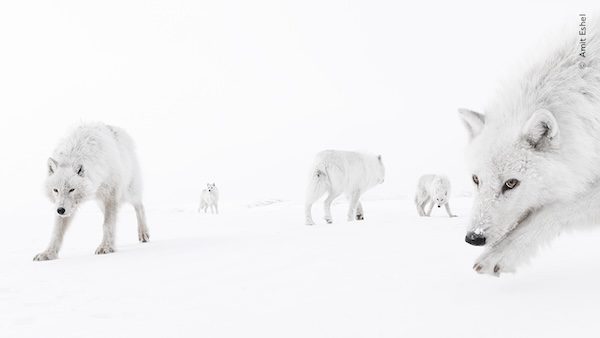
© Amit Eshel / Wildlife Photographer of the Year
In temperatures of -35°C (-31°F), Amit struggled to fulfill his dream of photographing the elusive Arctic wolves of Ellesmere Island in Nunavut, Canada. But then, on the twelfth day of his second trip, they came closer than he had ever imagined, so close that he could smell their breath.
Restricted to Canada’s most northern territories and northern Greenland, Arctic wolves are curious of humans due to a lack of interaction. They’re a snow-white subspecies of the grey wolf, pack animals that hunt hares and musk oxen.
Wake-up Call. Gabriella Comi (Italy) witnesses a dramatic stand-off between a lion and a cobra.
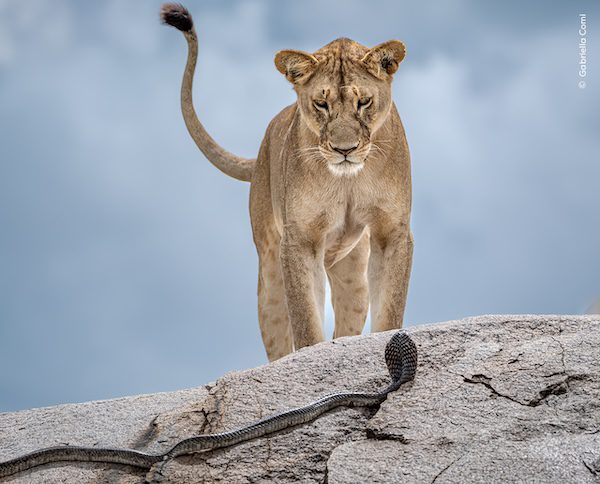
Energy levels among the lions were low in the scorching midday sun. Gabriella and her guide, David, were about to move on when David spotted movement – a cobra was slithering towards two sleeping lions. Within seconds, the eldest of the pair was facing down the venomous intruder.
Tanzania’s Serengeti National Park is renowned for its large population of lions, with around 3,000 individuals living there. Lions are estimated to sleep for up to 20 hours a day to conserve energy.
Comi revealed, “I don’t know how this lioness even heard (or felt?) the snake coming, but she went in seconds from sleeping beauty to savage goddess and engaged in a formidable face-off with the reptile. The whole scene lasted only minutes, and later involved also another female. Luckily enough, no venom was spit and no paws were bitten in this incident, but it was a close call for sure.”
No Place Like Home. Emmanuel Tardy (France) spots a brown-throated three-toed sloth clinging tightly to a barbed wire fence post.
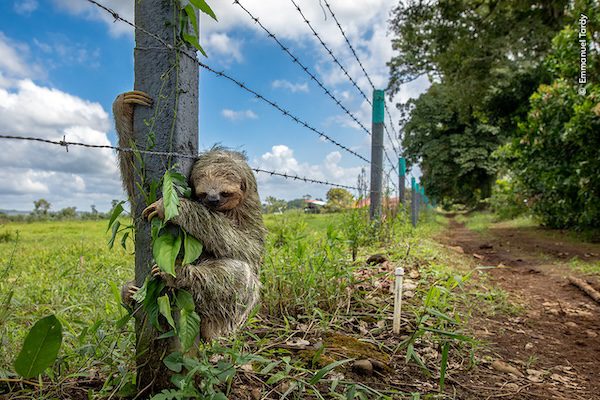
Traffic slowed to a crawl as this sloth crossed the road, eventually reaching a fence post and gripping firmly. Concerned about not adding to the animal’s stress, Emmanuel patiently waited for people to leave the area before quickly taking this photo.
As their habitats become increasingly fragmented, sloths are forced to make more ground crossings to reach the safety of the next tree. In response, the Costa Rican government is working with local NGOs to establish biological corridors, including aerial bridges that reconnect their forest homes.
Pink Pose. Leana Kuster (Switzerland) shows a greater flamingo in the act of scratching its head with one of its unmistakably long legs.
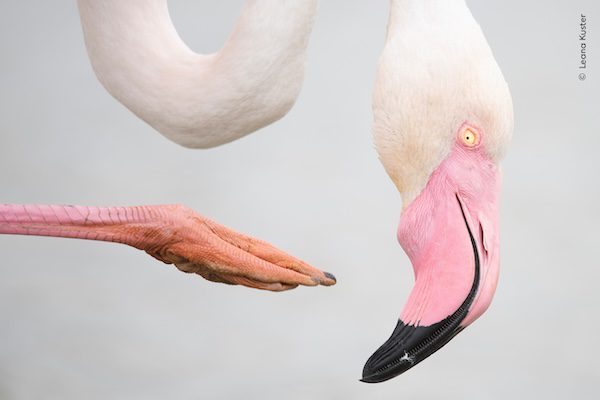
While on holiday in southern France, Leana had been watching flamingos in the Camargue. She was fascinated by their foraging behaviour as they moved gracefully through the shallow, saline wetlands, filter feeding for molluscs and crustaceans.
Flamingos use their tongues to force water through their specially adapted bills, which are lined with many rows of fine, comb-like plates. These help trap a species of brine shrimp called Artemia salina that gives the birds their famous pink hue.
Ice Edge Journey. Bertie Gregory (UK) freeze-frames the moment fledgling emperor penguin chicks walk along the edge of an ice shelf.
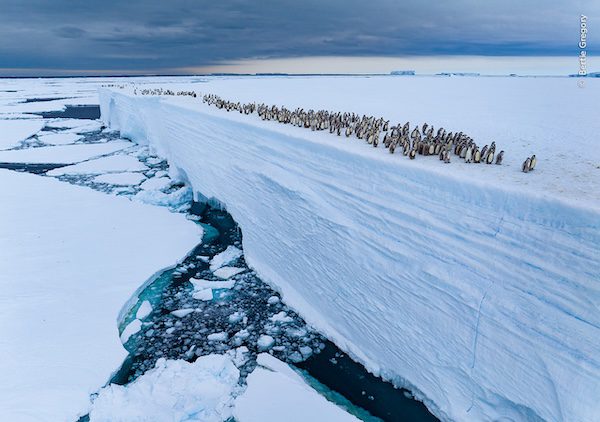
Bertie spent two months with the penguin colony and witnessed most chicks using ice ramps to descend to sea level for food. But this group missed the easy way down. Keeping his drone at a safe distance, he watched as they took a 15-metre (49-foot) leap into the water.
Left to fend for themselves, emperor penguin chicks must find a way to make their first dip into the icy ocean to find food. Scientists believe the continued decline of sea ice in Antarctica may force more penguins to breed on ice shelves, making this behaviour increasingly common in the future.
Rutting Call. Jamie Smart (UK) portrays a red deer stag as it gives a mighty bellow during the autumn rut in Bradgate Park, UK.
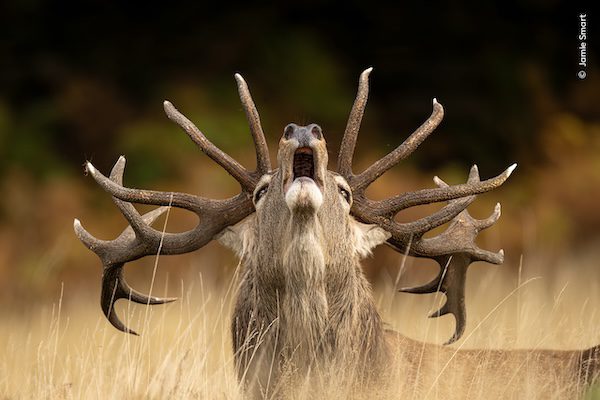
Jamie walked up and down a path in the park at a safe distance from the stag. She stretched herself up tall to avoid any long grass in the foreground spoiling her view.
The stag’s antlers have regrown since their annual shedding in spring. The ‘velvet’ – the soft skin that covered them during their growth – has now rubbed off, exposing the bone beneath. Each new set grows larger and more complex as the stag matures, with more intricate points called tines crowning the heads of older males.
Essence of Kamchatka. Kesshav Vikram (India) expresses the character of the remote wilderness of the Kamchatka Peninsula in Russia’s Far East.
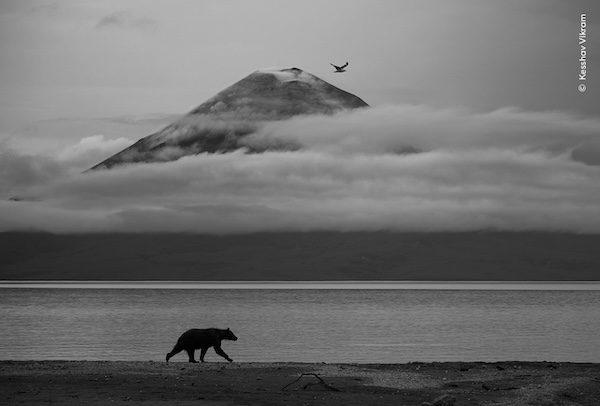
Kesshav waited days for this image to come together: a brown bear strolling along the shore of Kurile Lake as the Iliinsky volcano emerged from the clouds. A slaty-backed gull flew past, aligned with the volcano’s summit.
Generally solitary, the bear was heading to feast with others on the glut of sockeye salmon migrating upriver to their origin lake to spawn. This caldera lake, formed in the crater made by a volcanic eruption, is the largest sockeye salmon spawning ground in Eurasia.
Fragile River of Life. Isaac Szabo (USA) watches longnose gars spawn in a crystal-clear Florida river.
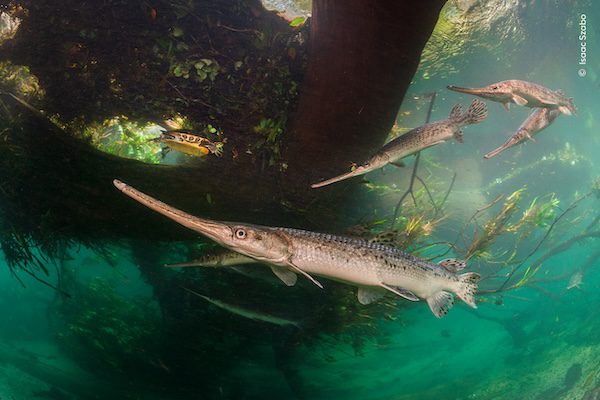
Wrapping his feet around a drowned tree, Isaac photographed this female longnose gar with several males during the mating season. The presence of the turtle was, for Isaac, the ‘icing on the cake’, as it ‘gives a sense of the whole ecosystem’.
This river is one of more than 1,000 waterways fed by freshwater springs renowned for their clarity. Maintaining the aquifers that supply these springs is vital not only for iconic wildlife such as manatees, but also for providing drinking water to nearly half of Florida. No bait was used for this photo.
Clouds of Gold. Jassen Todorov (USA) depicts the clouds reflected in salt ponds that span San Francisco Bay.
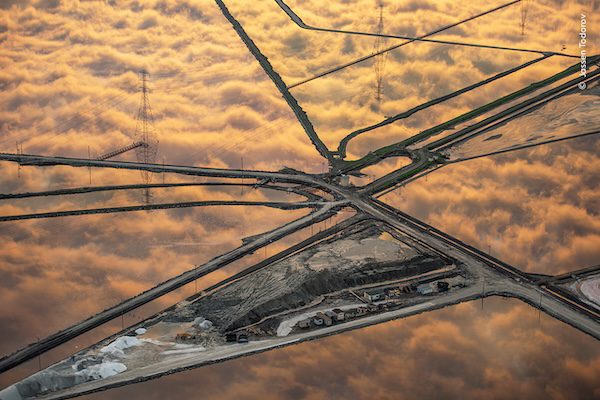
Flying his single-engine Piper Warrior into San Francisco International Airport, Jassen never tires of the changing colours of the ponds. On this occasion, he says, ‘the light during the golden hour, at sunset, was magnificent’.
The process of salt collection in the bay was industrialised in the 1800s. Since 2003, the South Bay Salt Pond Restoration Project has acquired 6,000 hectares (nearly 15,000 acres). By removing artificial dykes, the project is recreating tidal marsh habitat, allowing salt-tolerant plants and wildlife to flourish once more.
Slime Family Portrait. Kutub Uddin (Bangladesh/UK) spots a line of alien-like slime moulds on a fallen tree.
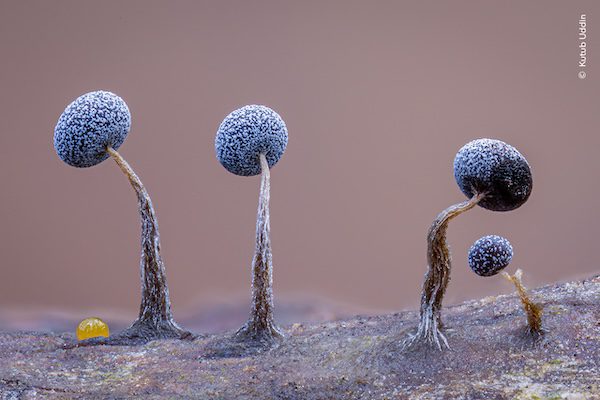
Kutub found these blueberry-like spheres – the reproductive parts of a slime mould, each just 1–2 millimetres in diameter – in a nearby forest. His image resembles a fantasy landscape, though he describes the scene as a ‘bizarre family portrait’, complete with a tiny yellow insect egg.
A slime mould is a community of mobile single-celled, amoeba-like organisms that live independently until they come together and work as one to find food and reproduce.
Deadly Lessons. Marina Cano (Spain) stumbles upon a group of cheetahs after they’ve caught a Günther’s dik-dik in Samburu National Reserve, Kenya.
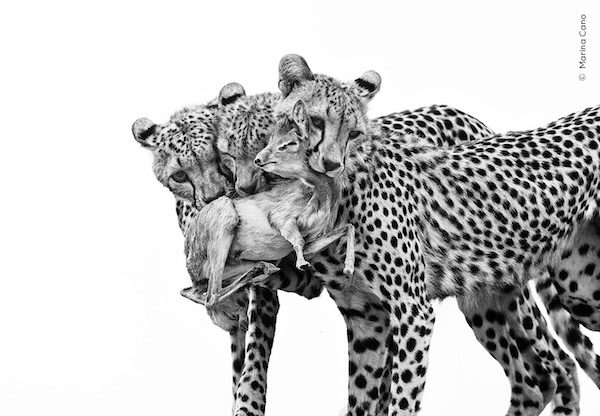
Marina watched the three young cheetahs practise their hunting skills while their mother looked on – a crucial stage in their journey to independence. The dik-dik was tossed into the air and killed just seconds after Marina took the photograph.
Cheetah cubs spend their first two months hidden in a lair while their mother hunts. At around a year old, they begin joining her, learning how to stalk and which prey to pursue.
A Tale of Two Coyotes. Parham Pourahmad (USA) uses the morning light to frame the amber eyes of a male coyote within the black-tipped tail of a female.
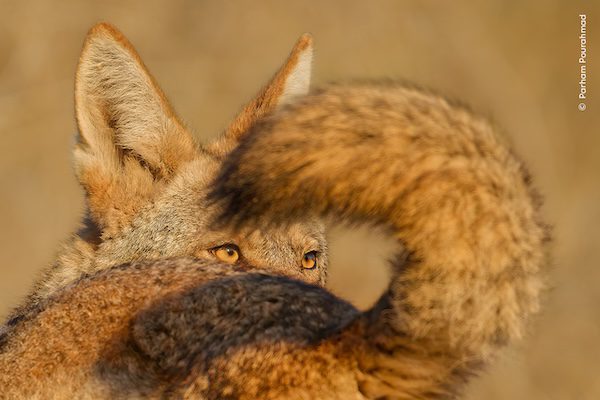
Parham followed this pair – a female and possibly her brother – for a couple of hours across the rocky hillside, quickly framing his image before the male turned to nuzzle the female.
Coyotes can adapt to almost any habitat and are abundant across North America and into Central America. Once common in San Francisco, they had disappeared from the city but are now beginning to return. While they do scavenge food waste, their diet also includes rodents and other small mammals.
Toxic Tip. Lakshitha Karunarathna (Sri Lanka) reveals a solitary Asian elephant navigating a waste disposal site in Sri Lanka.
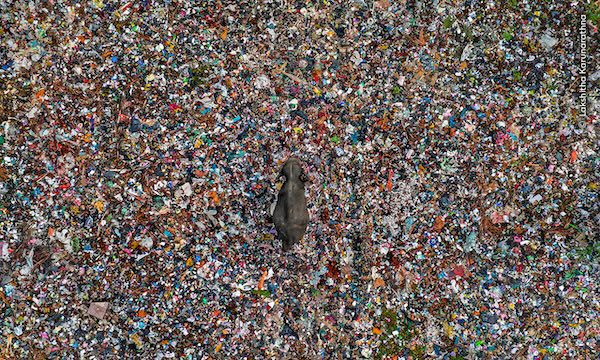
For over three years, Lakshitha has documented human–elephant conflict in Sri Lanka. This image is the result of months of meticulous observation at two open rubbish tips, where herds regularly forage.
Around 20 elephants died over an eight-year period at a single site in Ampara after consuming indigestible food wrappers and other plastic waste. Alongside global efforts to reduce plastic use, conservationists stress the urgent need to secure landfills and prevent wildlife from accessing harmful materials.
Jelly Smack Summer. Ralph Pace (USA) finds himself in the middle of a mass or ‘smack’ of Pacific sea nettles.
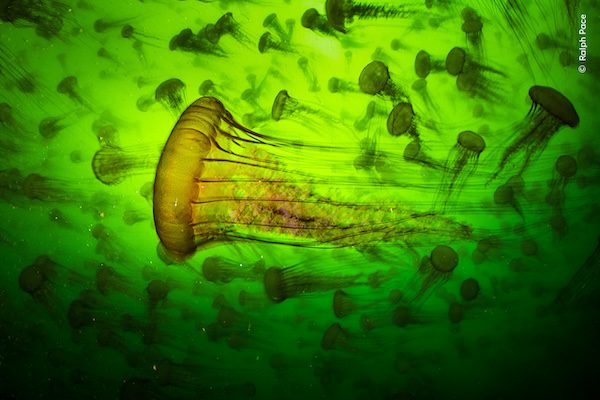
To try to protect himself from stings while taking this photograph, Ralph smeared petroleum jelly on any skin not covered by his wetsuit. The trailing tentacles can deliver a painful sting, which Ralph says feels more like that of a bee than a nettle.
Highly adaptable to warming seas, jellyfish are appearing in larger numbers. Some biologists argue that more frequent smacks are a sign of rising ocean temperatures. The removal of predators and competitors through overfishing is another contributing factor.
Nature Reclaims Its Space. Sitaram Raul (India) is among the chaos as fruit bats leave their roost in the ruins of a historical monument.
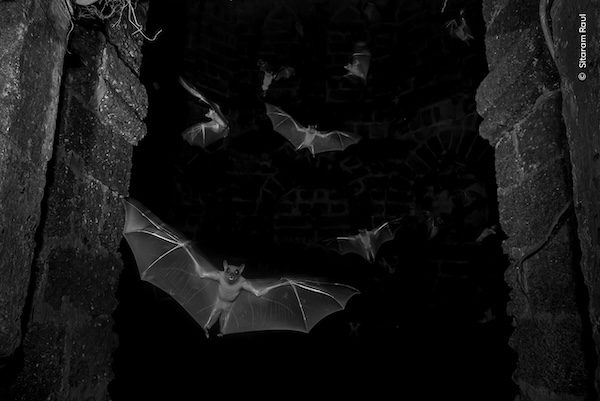
Working in total darkness, Sitaram manually focused his lens at the distance where he guessed the bats might appear, relying on his flash to illuminate the scene. All the while, bats were, in his words, ‘randomly pooping on me and the camera’.
Old World fruit bats are common across southern Asia. During the day, they roost in cavities such as hollow trees, caves and deserted buildings. Sitaram says that no matter how big our urban structures are, once we leave them, ‘eventually nature reclaims its space’.
Winners of this year’s competition have yet to be selected and will be announced on October 14, 2025.
Visit the Wildlife Photographer of the Year website for further information on the upcoming exhibition. To find out more about entering the annual competition visit www.nhm.ac.uk/wpy/competition.
The Wildlife Photographer of the Year exhibition helps visitors understand how our planet’s habitats are changing. Alongside the award-winning photographs, the sixty-first exhibition will provide insight into some of the habitats pictured by including the Natural History Museum’s groundbreaking metric, the Biodiversity Intactness Index (BII). BII measures how much of a region’s natural biodiversity remains on a scale of 0 to 100%. Adopted as an official Global Framework Biodiversity indicator for decision-making, it is an essential tool for understanding, monitoring and communicating biodiversity changes on a global scale and tracking international progress towards conservation goals.
Disclosure: This post may include affiliate links.