Hell Heron’: First New Dinosaur Species in 100 Years Discovered in the Sahara Desert
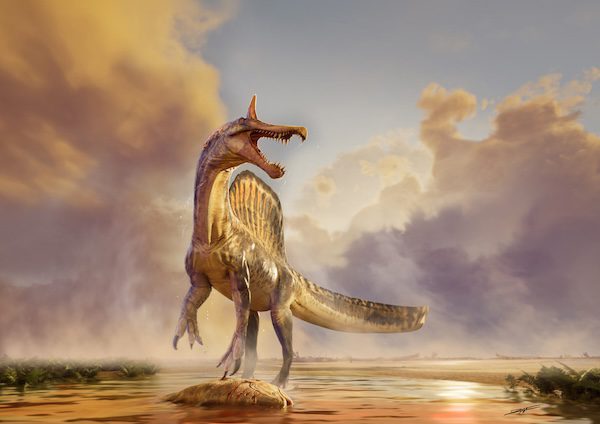
For the first time in nearly 100 years, scientists have announced the discovery of a remarkable new dinosaur species deep in the Sahara Desert — a predator that stretched roughly 40 feet long and sported massive claws and palm-sized teeth designed to hunt enormous river fish.
Estimated to have lived about 95 million years ago, Spinosaurus mirabilis (meaning “astonishing”) was unlike other Spinosaurus species, because scientists believe it lived on land, stalking prey along the edges of river waterways. Its size rivaled that of Tyrannosaurus rex, making it a formidable predator.
Nicknamed the “Hell Heron” it has a distinctive scimitar-shaped skull crest. At roughly 20 inches (about 50 centimeters) tall, the crest revealed grooves and inner canals that identified it as keratin, the same protein that makes up human hair and nails. Two other crests were unearthed in the same area, confirming that the crest was not a one-off deformity but distinctive to the dinosaur.
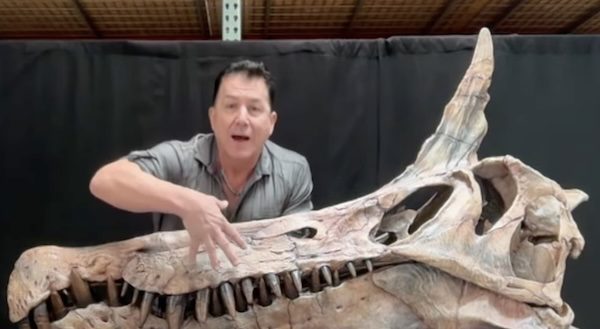
The mirabilis’s narrow snout was filled with long dagger-like teeth that scientists believe speared and trapped fish. Super-sized fish fossils have also been found in the area and were likely its prey.
The discovery was made by a team of 20 paleontologists ventured into the remote desert, hoping the shifting sands might reveal something extraordinary. After hours of searching, they uncovered a spine unlike any they had seen before.
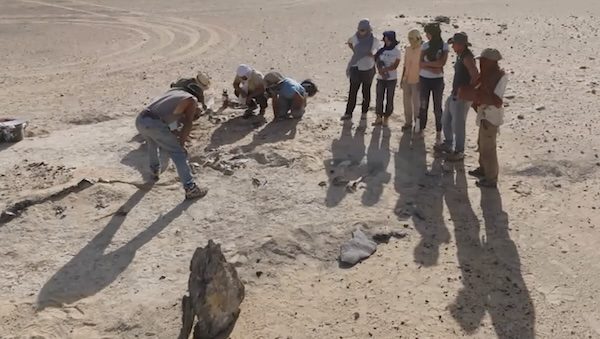
Dr. Paul Sereno of the University of Chicago says discoveries like this are just the beginning at this site.
“We’re in an age of discovery. We’re naming more dinosaurs now than we’ve ever named before,” he told ABC News. “Your kids and their kids are going to be in the heyday of dinosaur research.”
He added, “Not only are we going to find more, we’re going to name a lot more from that site. There are digging raptors you’ve never seen. There are crocodiles and all sorts of creatures that we have already found.”
He believes the African continent remains one of the last great prehistoric frontiers — a lost world still waiting to be unearthed.
The study of the discovery is published in Science.
Sign up to get a daily dose of positivity delivered right to your inbox with our newsletter.
Disclosure: This post may include affiliate links.