Underwater Photographer of the Year 2026 Winners Reveal Spectacular Ocean Images
From glowing rockpools to the hidden depths of the open ocean, the Underwater Photographer of the Year 2026 winners showcase some of the most breathtaking scenes captured beneath — and along — the world’s waters.
Among this year’s standout winners is an adorable pair of southern elephant seal pups, photographed in a rockpool on the Falkland Islands, which earned Australian photographer Matty Smith the title of Underwater Photographer of the Year (UPY) 2026. His image, Rockpool Rookies, triumphed over 7,900 photographs entered by underwater photographers from around the globe.
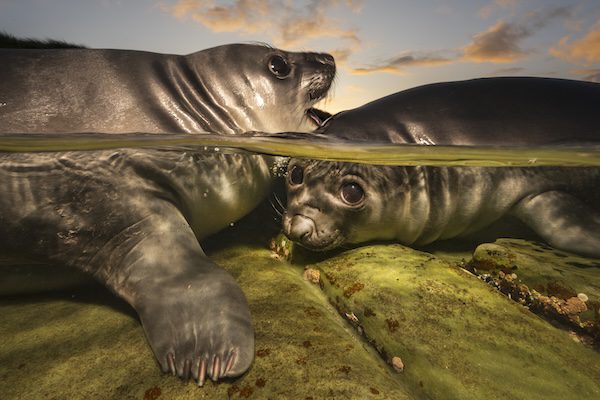
“Once their pups are weaned, elephant seal mothers abandon them ashore,” explained Smith. “I watched dozens clamber over one another in shallow rockpools, awkwardly learning to swim. On my very first evening, the sky ignited with colour and I captured a handful of frames before the light vanished. It was the defining moment of the long trip.”
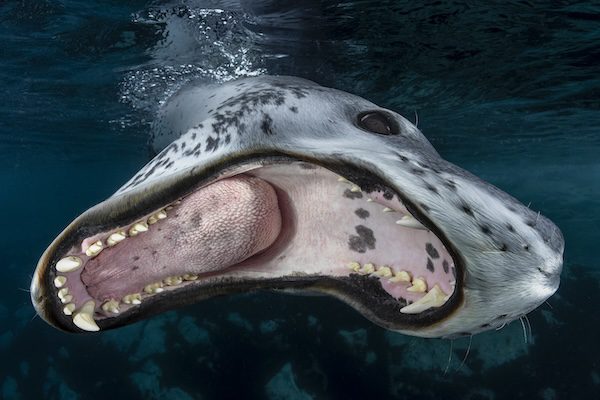
Sam Blount from the United States was named as ‘PADI’ Up & Coming Underwater Photographer of the Year 2026 for his photo “Lunging Leopard”, for his symmetrical composition of the jaws of a leopard seal, one of Antarctica’s top predators. “Leopard seals wield an astonishing array of dominance displays,” explained Blount. “This one put them all to use, darting around me with effortless power. Watching that massive mouth lined with sharp teeth charge straight toward me is a thrill I’ll never forget.”
The Underwater Photographer of the Year contest is based in the UK, and celebrates underwater life in the UK. Natalie Yarrow was named this year’s, “Most Promising British Underwater Photographer 2026.”
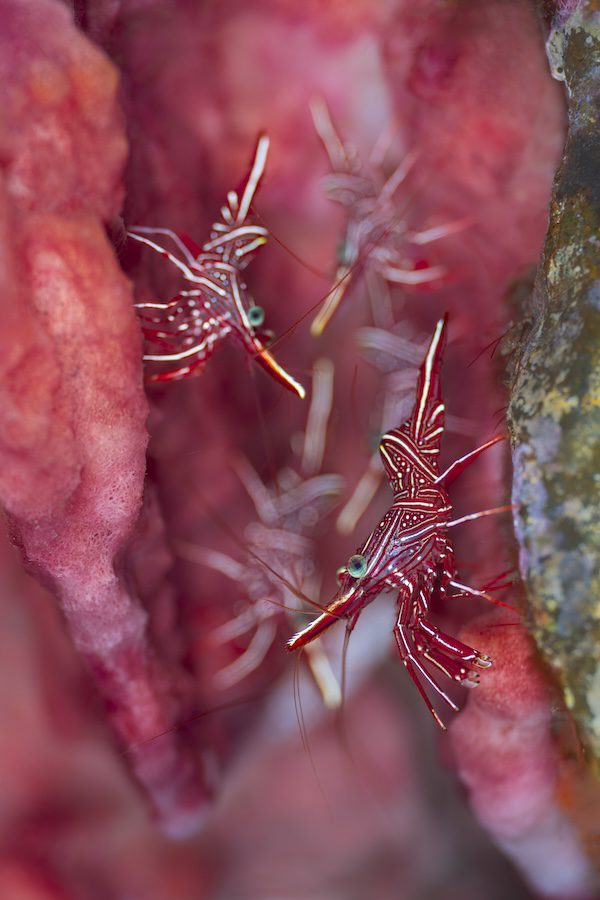
“Peering into the crevices of this vibrant barrel sponge, I could see several dark figures moving around like shadow puppets,” said Natalie Yarrow. “This turned out to be a large colony of hinge-beak shrimps, living together in very close quarters!”
See more of the astounding winners below.
Wide Angle
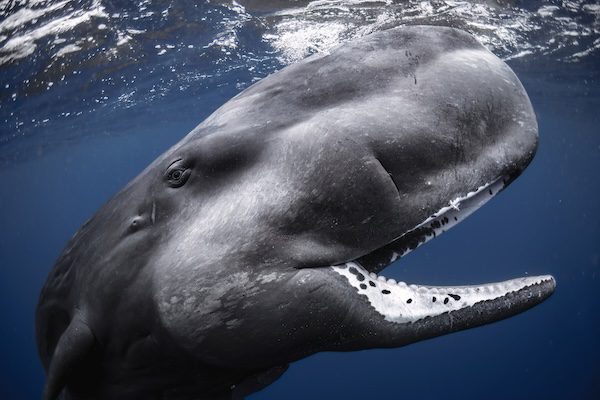
Category Winner: Cecile Gabillon Barats wrote, “We entered the water at a respectful distance alongside the mother and her calf, watching as the mother prepared to dive in search of food, leaving her youngster at the surface. Almost immediately, the calf spun around and approached us, coming remarkably close, mouth wide open to reveal his emerging teeth, rolling playfully upside down. It seemed he was eager to interact. We could clearly see a chunk of squid held in his jaw and the many scars already etched into his skin.”
“Over the years, I’ve photographed sperm whales countless times for documentaries and a feature film, but this unforgettable moment will always hold a special place in my heart. Looking back at the encounter, it’s tempting to believe he was smiling—and perhaps even about to give us a cheeky wink!”
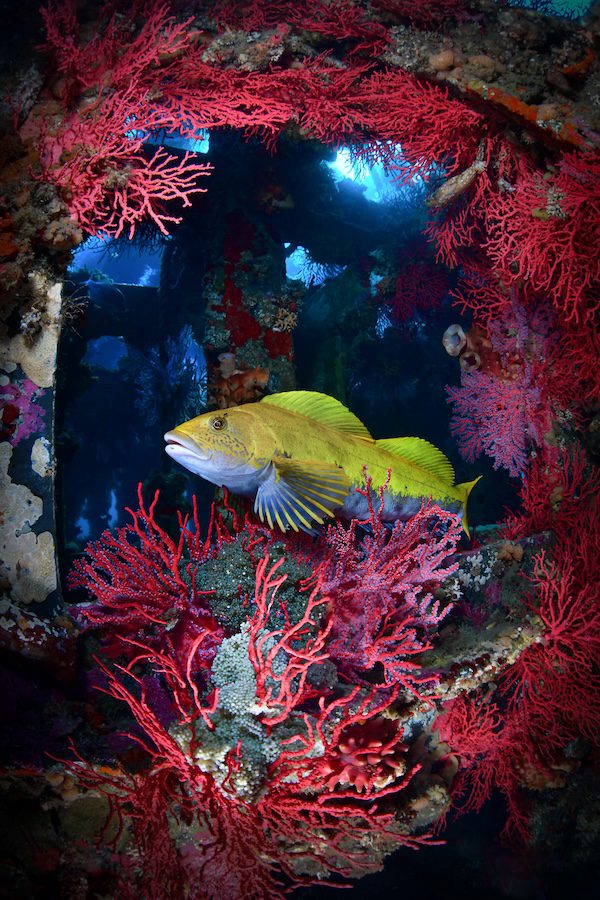
Runner-Up: “In the depths of the East Sea at the height of winter, a male greenling transforms into a brilliant golden sentinel,” Jinny Kim wrote. “This vivid coloration, triggered by his spawning hormones, serves both to attract mates and deter rivals. Photographed among the red soft corals of Jumunjin’s artificial reef, the male stands watch over his eggs, guarding them tirelessly until they hatch. The image reflects a moving moment of paternal devotion, an enduring act of protection shaped by instinct and sacrifice.”
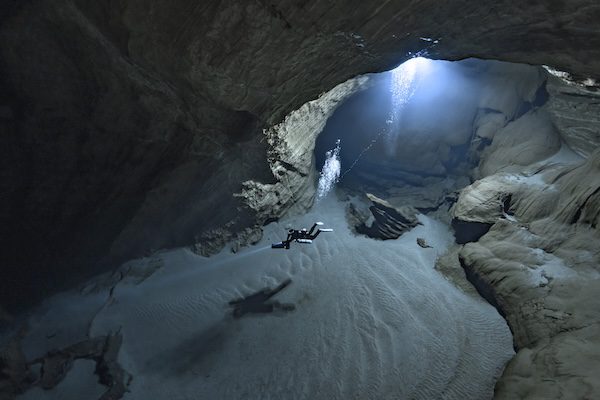
Third Place Winner: “This image was shot on the second dive in this cave. I realized that this space was where I wanted to do something special photographically,” Alex Dawson said of his photo. “The biggest challenge was the halocline, where fresh and salt water meet and mix right at the diving depth, turning the water into a blur. It’s also quite far into the cave, about 30 minutes runtime with our powerful SUEX XK DPVs.”
Macro
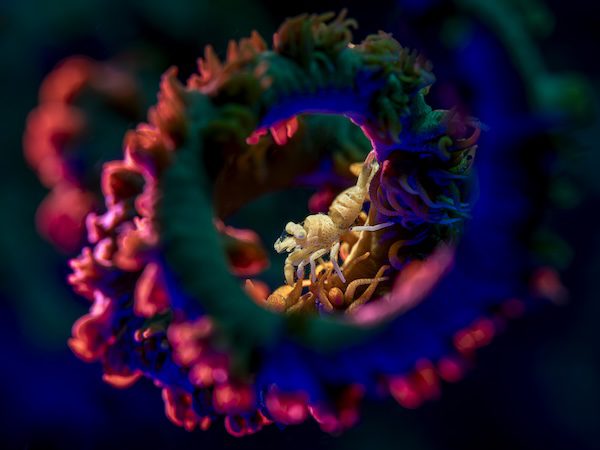
Category Winner: “While diving in Tulamben with my guide, Jaye, I encountered a commensal shrimp living within a naturally spiralling whip coral. Something I had long hoped to see. The coral’s deep, rich green formed a striking nest for the brightly coloured shrimp resting inside,” SeongCheol Cho said. “By introducing red and blue light against the green coral, I wanted to create a sense of intense beauty combined with visual turbulence, while expressing the shrimp’s stillness at the centre.”
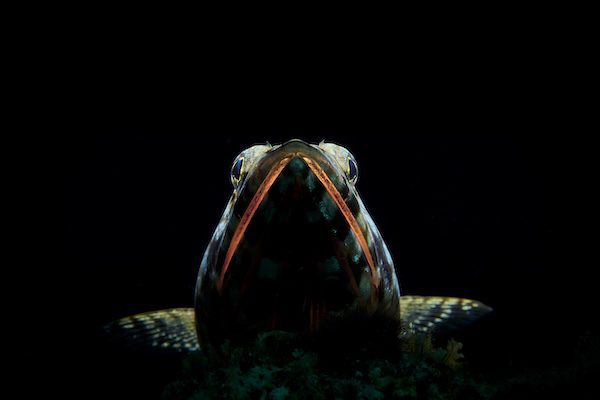
Runner-Up: “In Bohol, Philippines, lizardfish are common and easily overlooked reef inhabitants, typically encountered resting motionless on sand or rubble. With this image, I wanted to move beyond the predictable image of a sedentary ambush predator, and reveal an unexpected view of the species,” said Fabian Becker. “Lizardfish are surprisingly skittish at close range, requiring a slow and deliberate approach. Working alone, I carefully positioned a snooted strobe on an extra-long arm behind the subject, backlighting the head to completely isolate it from the environment and fundamentally alter its appearance.”
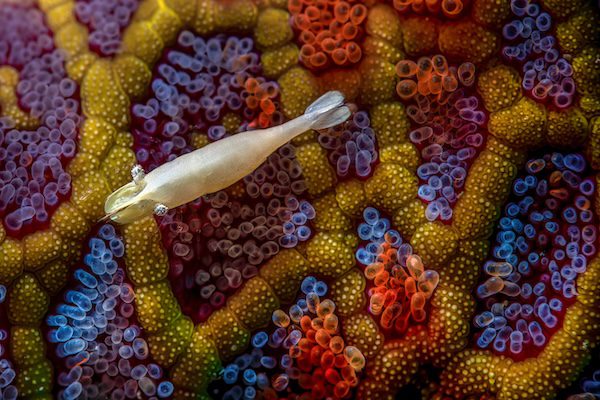
Third Place Winner: “I have a rather special spot near Shellharbour, New South Wales, my local dive site, just a short fifteen-minute drive from home. It’s a dive site bursting with life, and every dive there feels like an adventure. I always see mosaic seastars, and their bright colours always catch my eye. This time, I was lucky enough to find a tiny commensal shrimp, just about 20 millimetres long, nestled on one of the seastar’s arms,” Simon Theuma wrote. “The image reminds me of Aboriginal art and Dreamtime stories, speaking of the balance and connection that is woven throughout the marine world.”
Wrecks
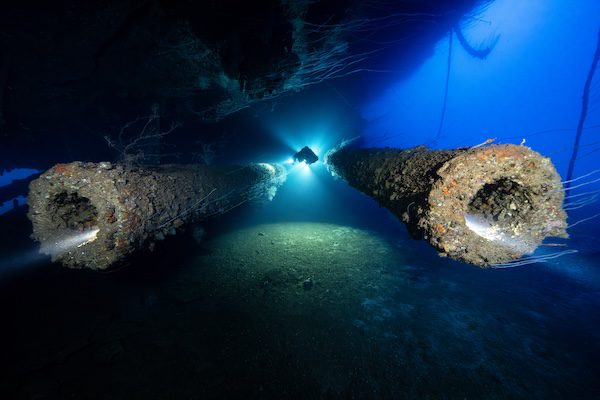
Category Winner: “IJN Nagato is a famed Japanese battleship from which Admiral Isoroku Yamamoto is said to have issued the order to attack Pearl Harbor. Seized by the United States at the end of World War II, she was later towed to Bikini Atoll and used as a target ship during Operation Crossroads, the early nuclear weapons tests,” said Niclas Andersson. “Today Nagato rests upside down at roughly 52 meters, making it a demanding but highly rewarding dive. On descent, divers are greeted by four enormous propellers, while the standout features are the twin stern guns, best approached from the port side.”
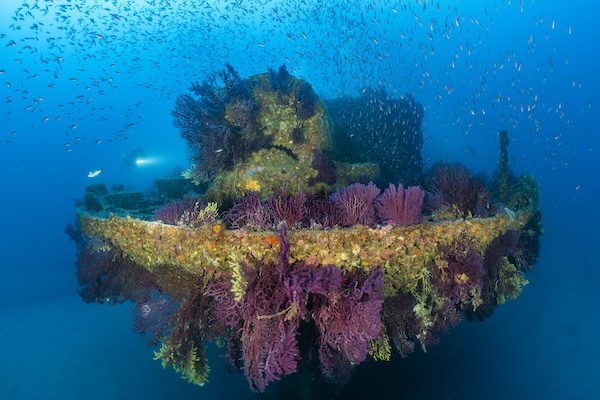
Runner-Up: “The Donator, or Prosper Schiaffino, is a cargo ship wreck that was sunk by a mine in 1945. It is one of the most famous wrecks on the French coasts of the Mediterranean Sea. This wreck is an amazing artificial reef. Every inch of it is covered in life. Gorgonians, sponges—it’s a beautiful mix of colors. It shelters a very important fauna, with thousands of anthias, large schools of all kinds of fish, groupers, dentex and more,” Jean-Baptiste Cazajou said.
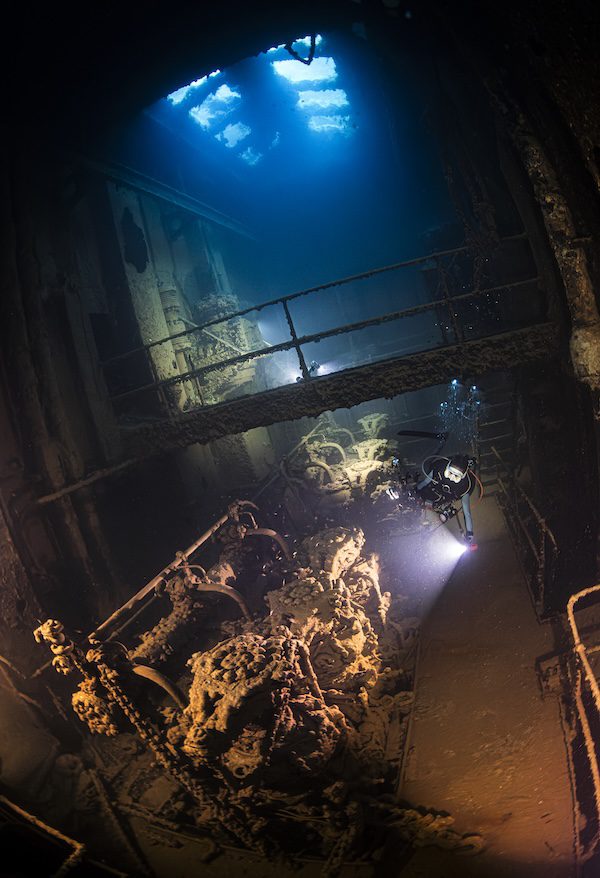
Third Place Winner: “This engine room of the Kensho Maru is one of the most iconic and popular photographic sites in Truk Lagoon. With careful pre-planning, I brought in five video lights to precisely illuminate the engine piston, spare piston, and the ladder leading to the catwalk, balancing them with the natural light filtering through the skylight,” Atsushi Hori wrote. “While shooting, another group of divers ascended from the lower level and entered this beautiful space…This moment connects human presence with the silent remains of history beneath the sea.”
Behavior
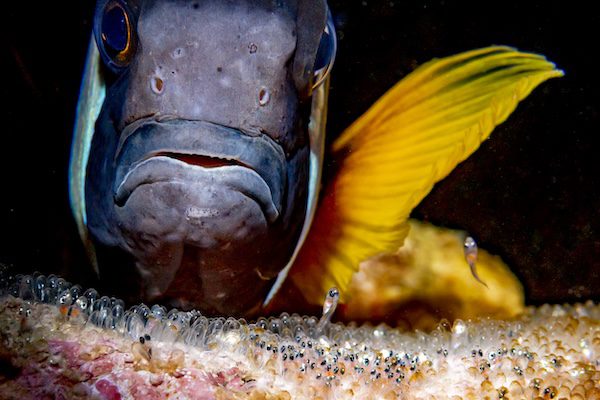
Category Winner: “This photograph captures the exact moment clownfish eggs hatch in Kagoshima Prefecture, Japan. In the late afternoon, my close friend Koji Matsuda told me that the eggs would hatch that day,” wrote Kazushige Horiguchi. “Even before hatching, the parent clownfish carefully guarded the eggs, constantly watching for predators as they waited for the moment to come. I was able to capture the instant the larvae emerged.”
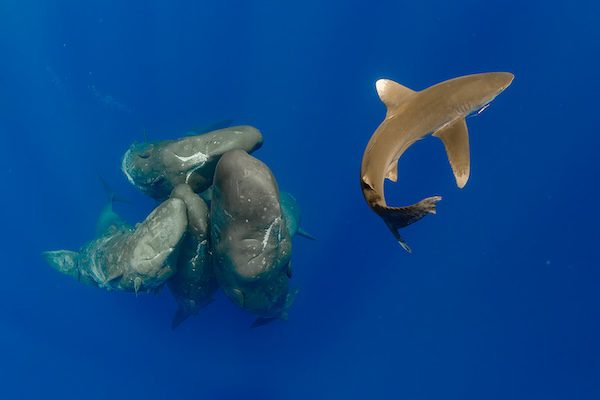
Runner-Up: “A rare and unexpected behavioural observation. A group of sperm whales (Physeter macrocephalus) were engaged in social behaviour at a depth of approximately 20 m. While descending and attempting to align the camera housing viewfinder with my mask to frame the scene, a sudden movement in my right peripheral vision drew my attention,” described Ventura Romero. “Within seconds, an oceanic whitetip shark (Carcharhinus longimanus) appeared in front of me, briefly approached and visually assessed me, then abruptly turned and retreated. Approximately 30 seconds later, the shark returned, swimming directly toward me at a closer distance. At that moment, the group of sperm whales adopted a compact, head-forward formation resembling a battering ram and rapidly ascended from depth, orienting toward both my camera and the shark. The shark immediately fled the area, followed by a pursuit by the sperm whales that lasted several minutes.”
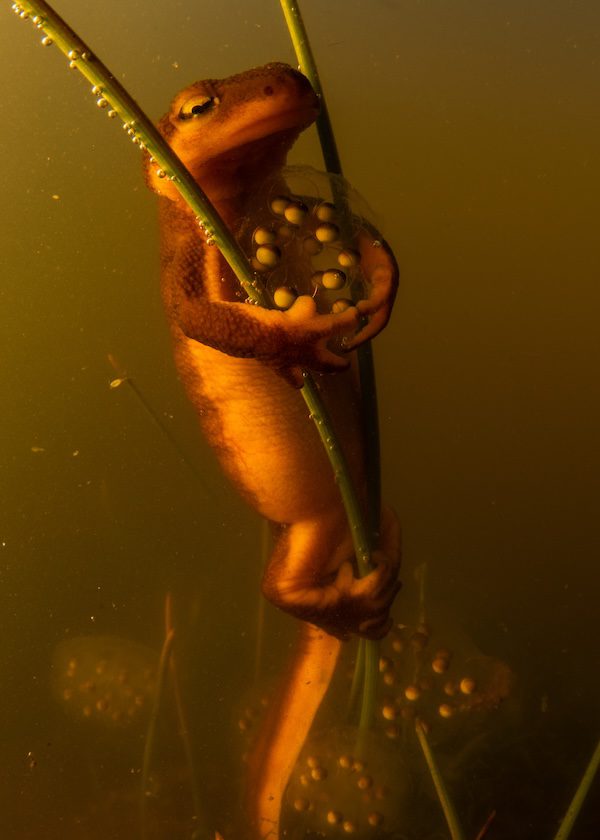
Third Place Winner: Anton Sorokin wrote, “A female California newt holds onto vegetation and a previously laid clutch from another newt to anchor herself in place as she begins to lay her eggs. Her holding onto the eggs this way is a lucky coincidence, but made for a exciting photo opportunity.”
Portrait
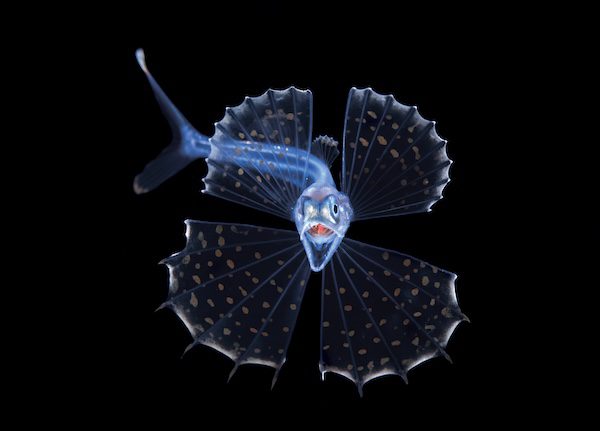
Runner-Up: “Every year off the coast of Florida, from late July to early October, Kali colubrina, a fish belonging to the family Chiasmodontidae and commonly known as snaketooth fishes or swallowers, makes an appearance during blackwater dives. Fish in this family are renowned for their ability to consume prey larger than themselves, with mouths and stomachs capable of expanding to accommodate prey up to twice their length and ten times their weight,” wrote Steven Kovacs. “Once encountered, they are notoriously difficult to photograph, as they have the annoying habit of hanging upside down in the water column, looking straight down. I was very lucky one night to come across this beautiful individual, fully displaying its elegant fins….it suddenly decided to yawn, and fortunately I was able to react quickly enough to capture this image.”
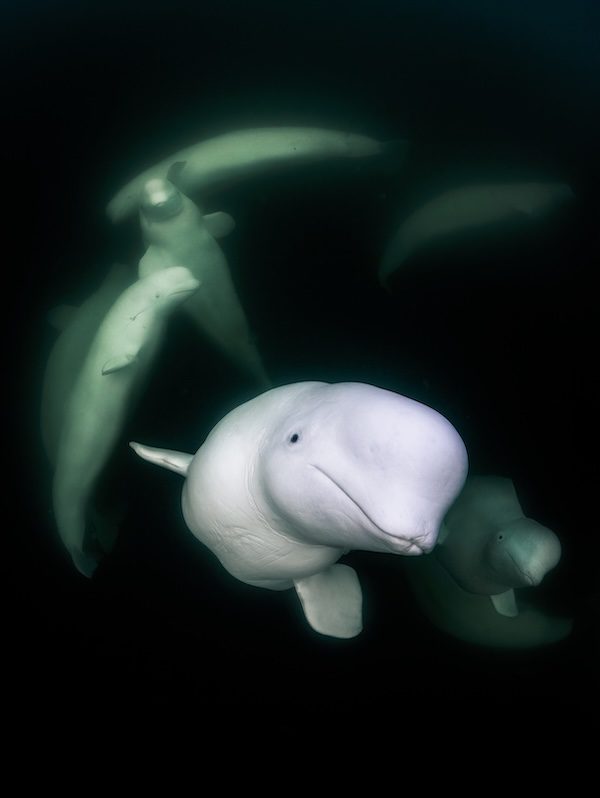
Third Place Winner: “Floating on a board with my head and arms submerged, I experienced something truly unforgettable. The belugas came and went freely, approaching me on their own terms, meeting my gaze, vocalizing, and observing with unmistakable curiosity. Laughing with emotion, I responded with a high-pitched voice, which made them even more curious. At times, they gently touched the dome of my camera, as if investigating me in return,” described Merche Llobera.
“I traveled to Churchill specifically to photograph belugas, but I never anticipated such close, voluntary interactions,” Llobera continued. “My intention was simply to be present, to enjoy the moment, and to create the best image possible while always allowing the animals to set the pace. Photographing from the surface, half submerged on the board, made the encounter feel genuine and unforced. There is nothing more powerful than a real connection with wild animals, one built purely on mutual curiosity. In those moments, I couldn’t help but wonder who was truly observing whom.”
Coral Reefs
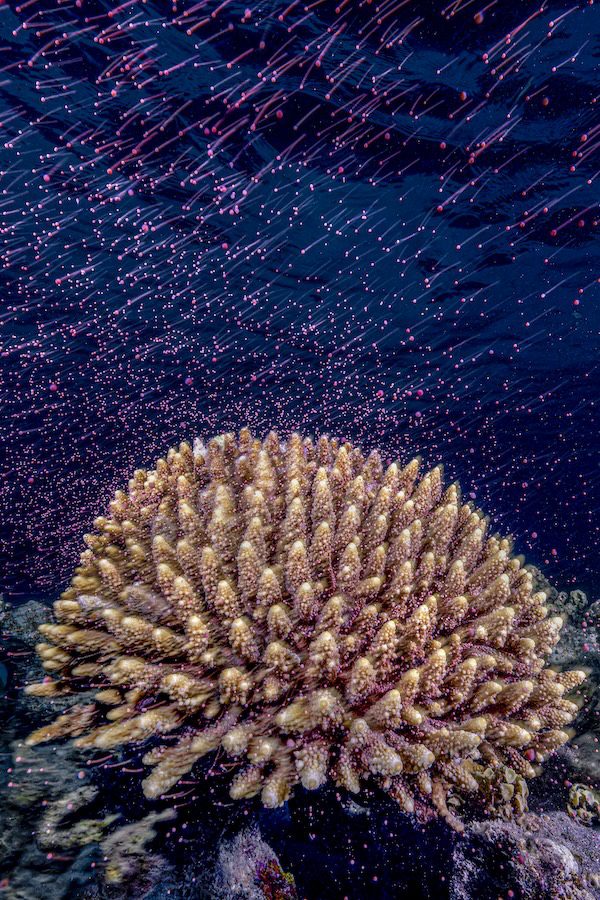
Category Winner: “Corals are animals, and this is how they reproduce. Revealing the hidden world of coral reproduction exposes one of the ocean’s most extraordinary spectacles. Like clockwork, thousands of corals across hundreds of kilometers synchronize to release egg-and-sperm bundles into the open sea,” Dr. Tom Shlesinger said. “Capturing this fleeting event is exceptionally challenging: it occurs only once a year, on a specific night of a particular month, within a narrow window of just minutes.”
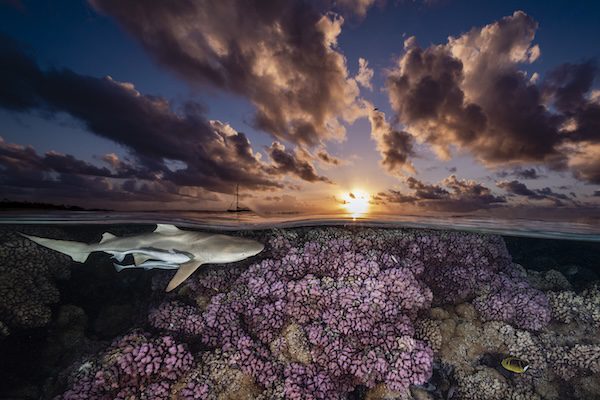
Runner-Up: “This half and half image of a shark patrolling a vibrant coral reef at sunset was shot in Fakarava, a coral atoll in French Polynesia’s Tuamotu Archipelago renowned for its pristine ocean environment,” Renee Capozzola wrote. “Designated a UNESCO Biosphere Reserve in 1977, sharks thrive here in their natural habitat due to strong protections. Sharks signify a balanced reef ecosystem so it is my hope that this image can help serve as a model for successful conservation and sustainability.”
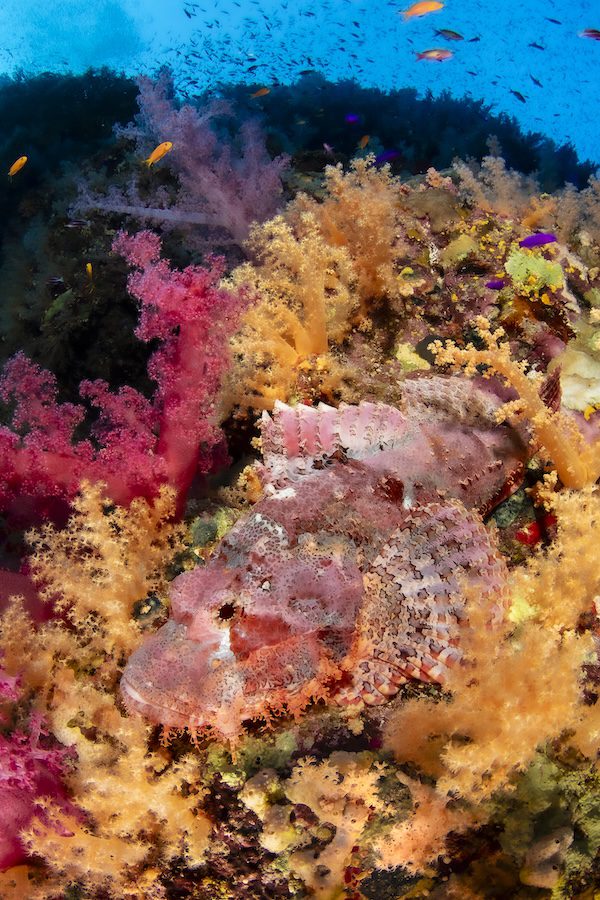
Third Place Winner: “The Red Sea scorpionfish is a master of camouflage, perfectly adapted to the vibrant reefs of Ras Mohammed National Park. Here, on Shark Reef, it blends effortlessly with the soft corals, relying on its textured skin and mottled colours to remain invisible to both predators and prey. Common throughout the Red Sea, this ambush hunter waits motionless for small fish or crustaceans to pass within striking distance. Despite its beauty, it carries highly venomous spines along its dorsal fin, an effective defence that makes it one of the region’s most formidable reef inhabitants,” said Neil Rosewarn.
Black & White
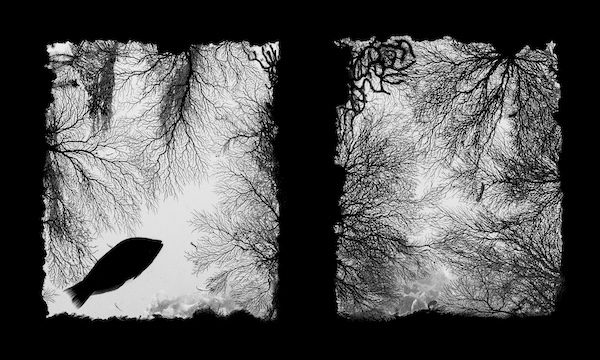
Category Winner: Shunsuke Nakano wrote of his image, “Gorgonians fan outward like frozen breath, turning rust into art. Between them, a lone wrasse punctuates the frame, providing movement in an otherwise still composition. Off Sado Island, the past is not lost, it is inhabited. The window no longer looks out; it invites us to look in, framing the story of nature reclaiming metal.”
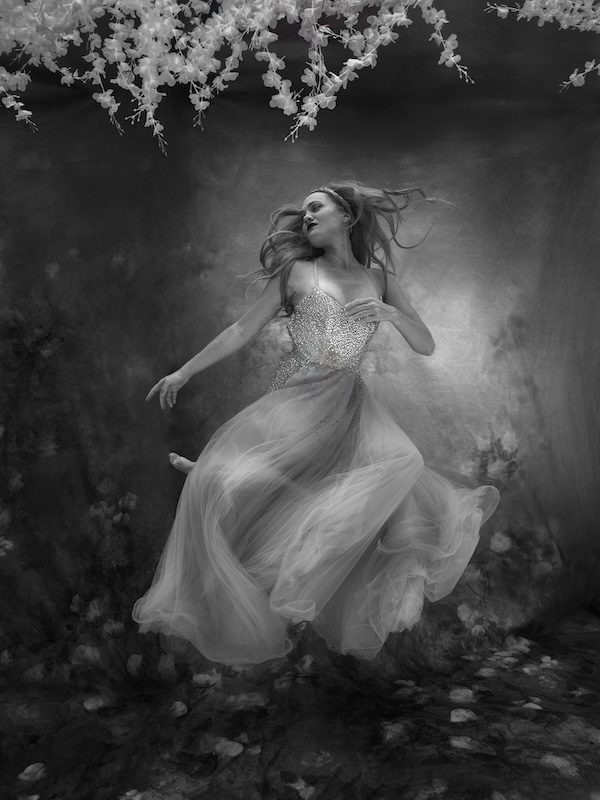
Runner-Up: “In addition to my seascape and marine life images, I’ve been lucky enough to work with fashion models, freedivers, and sometimes even mermaids in a range of environments. This particular image was shot in a pool set up like an above water studio,” wrote John Pfisterer.
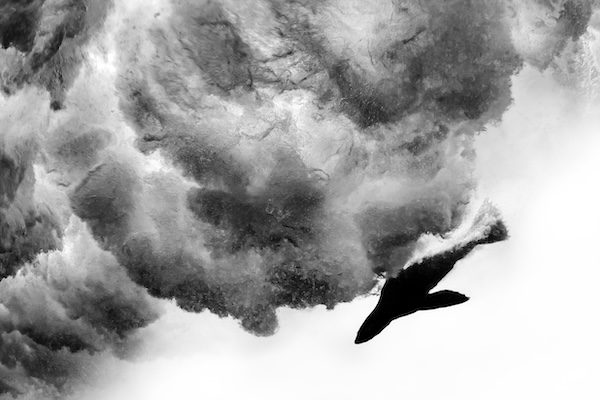
Third Place Winner: “December in Cape Town and the young fur seals are super active, playing in the waves as they crash onto the jagged rocks of Duiker Island. Joining them in the surf is exhilarating, though photography is incredibly difficult,” David Alpert. “These animals shoot through the swell like lightning bolts; there is no time for autofocus, only instinct. I have returned to this spot for over five years to capture this exact moment. Sadly, such an experience is currently unattainable as seal colonies along the Cape coast struggle with a rabies outbreak. One wonders if these encounters will ever be safe again.”
Up & Coming
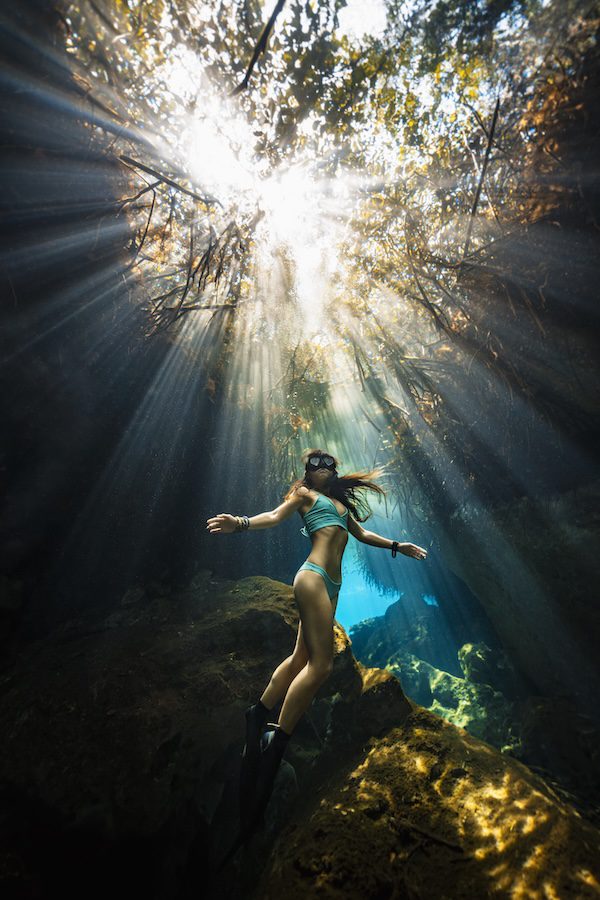
Runner-Up: “My wife was snorkeling at the surface while I was below on scuba, in the mangroves of Casa Cenote. As I encountered this magical scene, sunlight filtered through the canopy above, creating ethereal beams that illuminated the crystal-clear water,” said Khaichuin Sim. “I used hand signals to ask my wife to free-dive to the perfect spot, where she gracefully suspended herself underwater, appearing to dance with the light.”
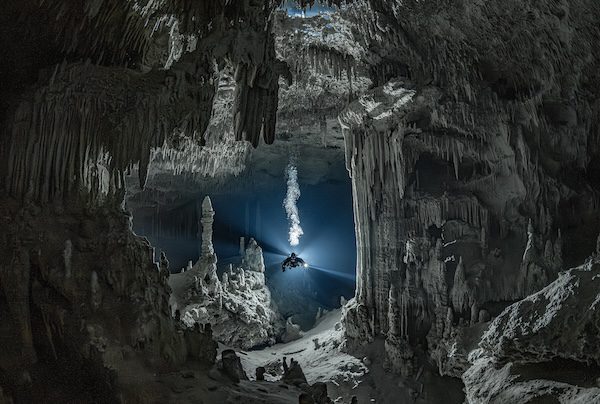
Third Place Winner: “‘Heaven’s Gate’, a breathtaking section of the Nohoch Nah Chich underwater cave system in Mexico, is where I took this photo. The experience of entering this space felt less like a simple passage and more like a journey across time, a profound shift from the present into the distant past,” Jinny Kim said.
Compact
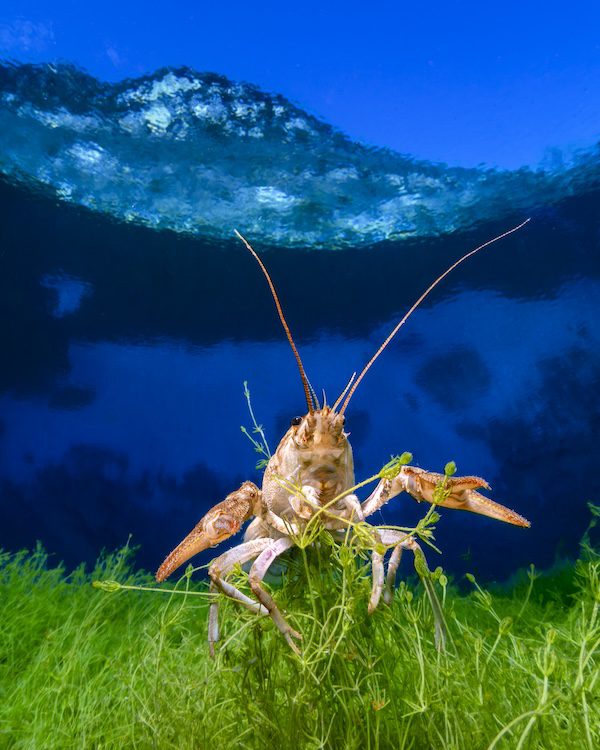
Category Winner: “After years of waiting, I dived into a cold Alpine lake near my home in northeastern Italy. Its clear, deep-blue waters rise from a spring, making it a gem among the mountains,” said
Andrea Michelutti. “Low nutrients favour green algae growth, the constant low temperature (around 9–11 °C) contributes to the water’s clarity and unique colour. Life is sparse, but I spotted a freshwater crayfish (Austropotamobius pallipes) among the aquatic plants. Impetuous, it swam toward me until it was touching my wet lens…The composition I’d planned for years is built on the transition from green vegetation to deep blue water, with mountain peaks framed in Snell’s Window.”
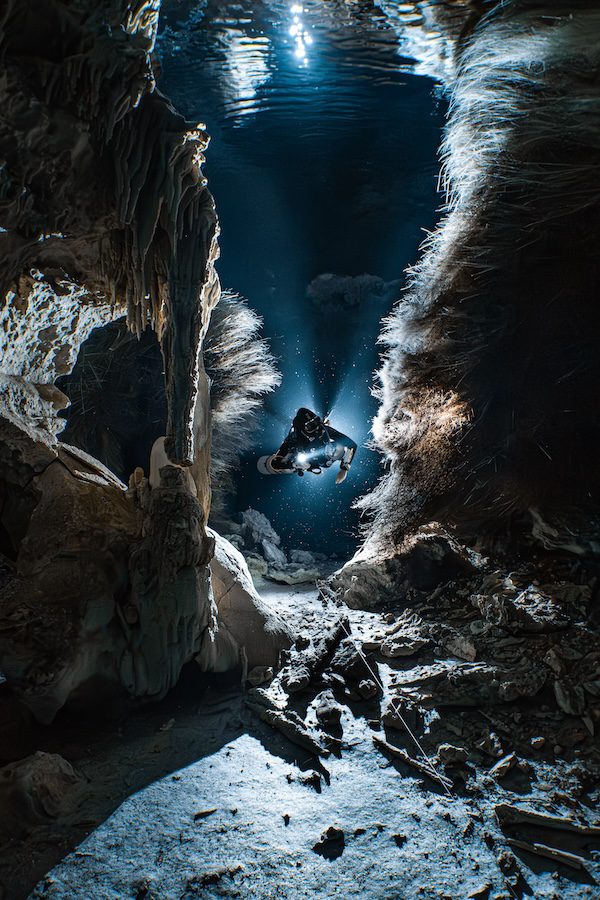
Runner-Up: “Cenotes have always fascinated me – these ancient windows into the underworld where light, water and geology meet. In the Cenote Dos Pisos, I discovered a chamber whose ceiling was pierced by powerful roots,” Manuel Wüthrich said. “They reached deep into the water like veins, connecting the subterranean world with the life above. To capture this image, we planned a special cave dive to reach the exact spot under safe and optimal conditions. For a brief moment, everything seemed to merge: stone, water, light and time. In that silence, nature felt like a single, breathing organism.”
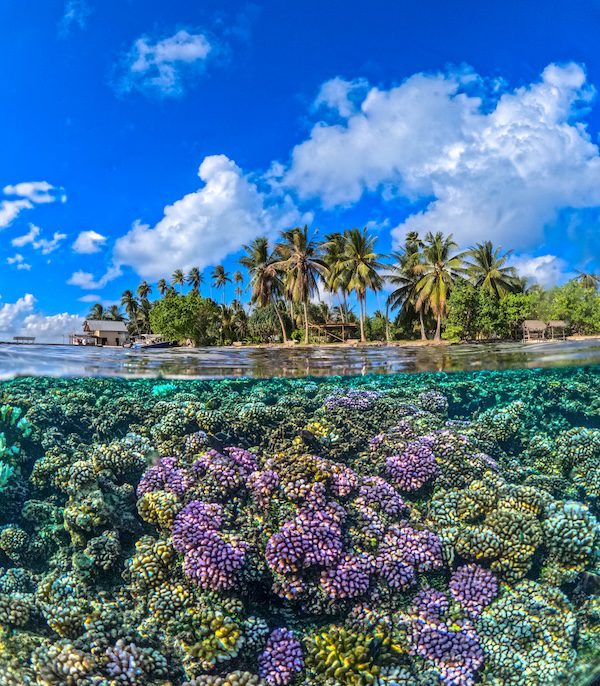
Third Place Winner: Rémi Conte wrote, “This image was taken in the lagoon of South Fakarava, French Polynesia, close to the southern pass, within a UNESCO Biosphere Reserve. While the pass is world-famous for its spectacular shark dives, it was the lagoon that drew me back again and again. Whenever conditions were calm, I entered the water to explore these shallow reefs, remarkable for their clarity. I returned to this spot several times, spending long hours in the water waiting for the right light and surface conditions to create this split shot.”
Smartphone
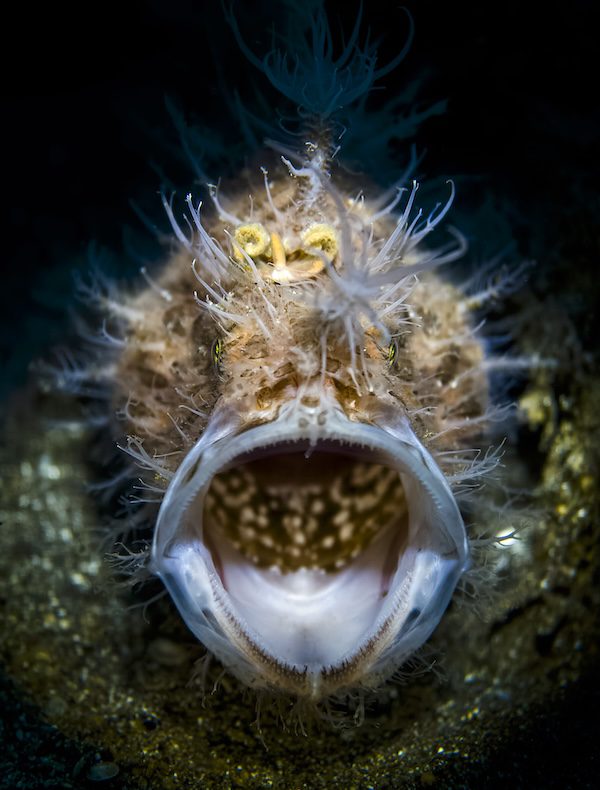
Category Winner: “While shooting on the sandy seabed at 15 meters in the Lembeh Strait, Indonesia, I found this well-camouflaged frogfish patiently lying in wait for prey. I waited for at least 15 minutes,” Jack Ho said. “To get a clean shot against the messy background, I aimed a macro light at its head to capture the split second it opened its huge mouth. Luckily, I got the perfect moment.”
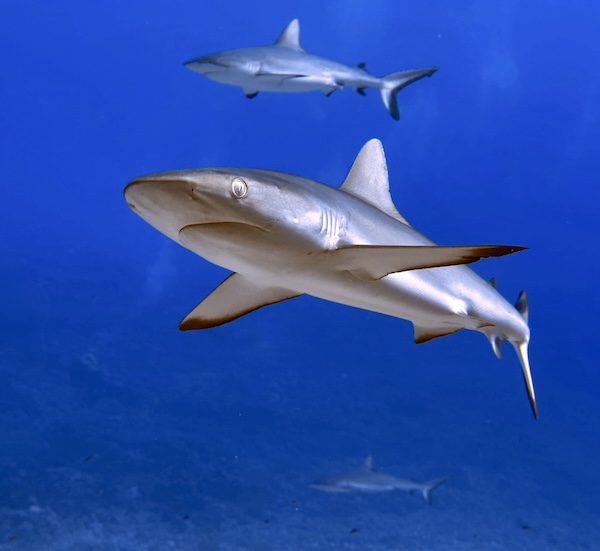
Runner-Up: “This image was taken in the South Pass of Fakarava, inside the legendary ‘Wall of Sharks.’ Carried effortlessly by the strong current, I had no time to plan or compose, only to feel, observe, and react. Suddenly, a gray reef shark filled my frame, its gaze calm, curious, and powerful. Behind it, other sharks fade into soft blur, hinting at the hundreds surrounding us,” said Clotxa.
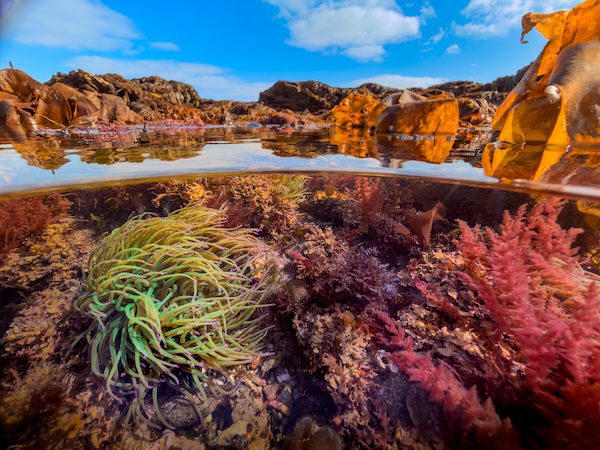
Third Place Winner: “Existing at the threshold of land and sea, the intertidal is a world of harsh extremes. It’s also a world of enormous biodiversity, concentrated into a relatively small area, and one of my favourite places to visit. I’m also a big fan of splitshots and couldn’t resist trying to see what was possible with a smartphone and dome port, and in trying to capture the diversity of the intertidal zone,” Martin Stevens said. “This photo is of a snakelocks anemone, set amongst the kelp and colourful seaweed of the Cornish rocky shore, on a low spring tide, showing the beauty of this diverse environment on the doorstep of a major town.”
‘Save our Seas Foundation’ Marine Conservation
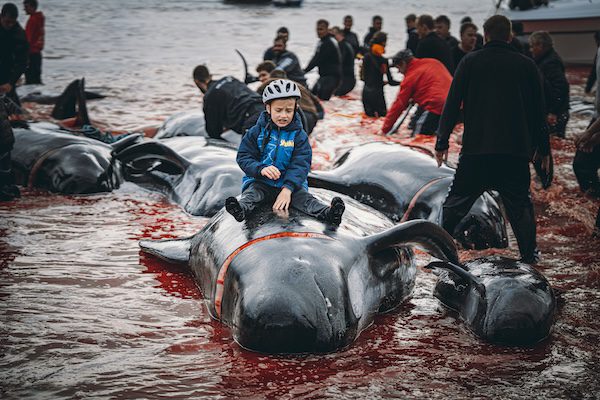
Category Winner: “In the Faroe Islands, the annual pilot whale hunt known as Grindadráp, remains one of the world’s most controversial traditions,” Khaichuin Sim said. “Seen by locals as a cultural heritage and source of food, it is condemned globally for its brutality and impact on marine life. In this poignant scene, a young boy sits atop a slain whale amid blood-red waters, a haunting reflection of how tradition, identity, and ethics collide. It captures not just a moment, but a generational question: what should be preserved, and what should change?”
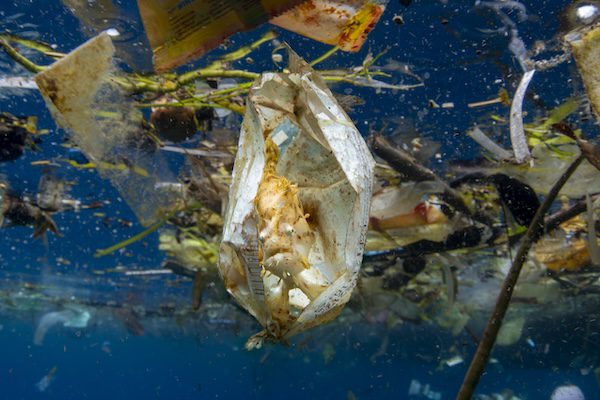
Runner-Up: Ross Makulec wrote, “After spending 40 minutes documenting an underwater cleanup effort by the guides from Lembeh Resort, we ascended and decided to refocus our efforts on the large patch of trash floating at the surface. Almost immediately, the dive center manager, Charlie, shouted that he had spotted a sargassum frogfish amongst the refuse. While the guides continued to pick up trash, I followed this frogfish as it swam from plastic to plastic, making its home not among the sargassum seaweed for which it is named, but the detritus we discard without thought. My goal was to capture this unique species in its unnatural home in order to highlight the continued struggle the ocean and its inhabitants face due to the waste produced by human society.”
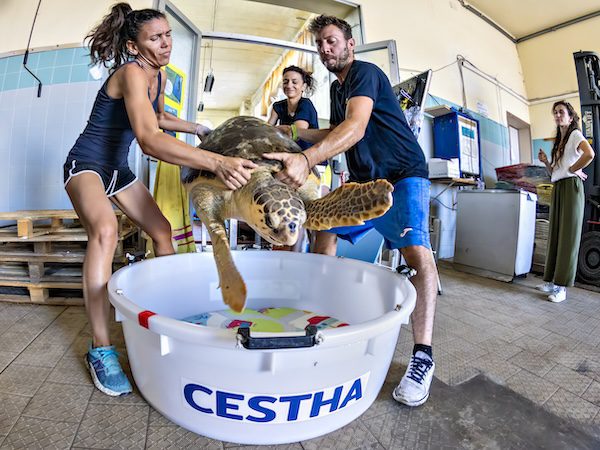
Third Place Winner: This image is part of a photographic reportage produced at the CESTHA marine rescue centre in Italy, documenting the daily work behind marine wildlife rehabilitation,” wrote Ilaria Mariaguilia Rizzuto. “The turtle is a large adult female, estimated to be around 45 years old, being moved from the therapy tank into a tub for transport to the sea after months of care. Her release took place within an hour, just off the coast of Ravenna. My goal was to show the human side of conservation: coordination, responsibility and effort.”
British Waters Wide Angle
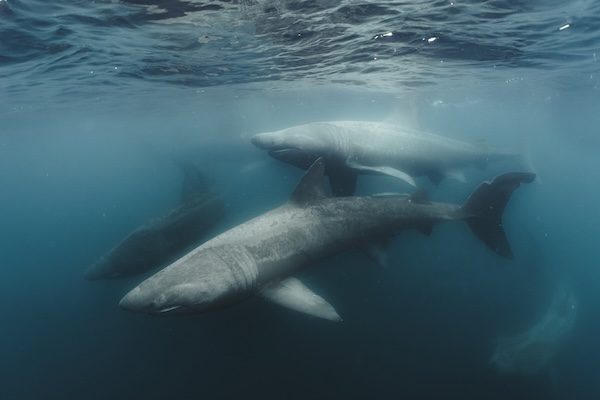
Category Winner: “What started out with 2 large sharks feeding at the surface turned into 3, then 4, then 5 over the course of the day. At some point most of the sharks had gone, and after watching the last tail fade away, I turned around and was greeted with the image here,” Evan Johnston said. “These sharks had stopped feeding and formed a tight shoal, before breaking off and swimming in slow rhythmic circles, eventually spiralling off into the deep. This behaviour is known as a Torus and is thought to be a courtship behaviour and the precursor to mating – although that remains a mystery.”
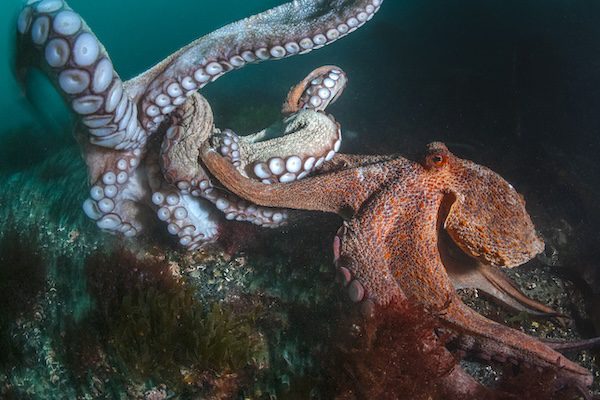
Runner-Up: “2025 has truly been the Year of the Octopus in southern England, as these eight-armed wonders have taken over coastal reefs in significant numbers. Porthkerris in Cornwall has been a particular hotspot for divers to see them,” Kirsty Andrews. “As dusk fell and darkness started to descend, I followed a large, confident individual, patrolling and making fascinating poses as it moved. Turning a corner, it chanced upon another large octopus, and suddenly the two sprang together into this mysterious scene…My guess is that it was at least in part a mating overture, as within moments the two cephalopods had enveloped each other in a tight embrace and I watched intrigued as they moved off together into the kelp forest.”
British Water Macro
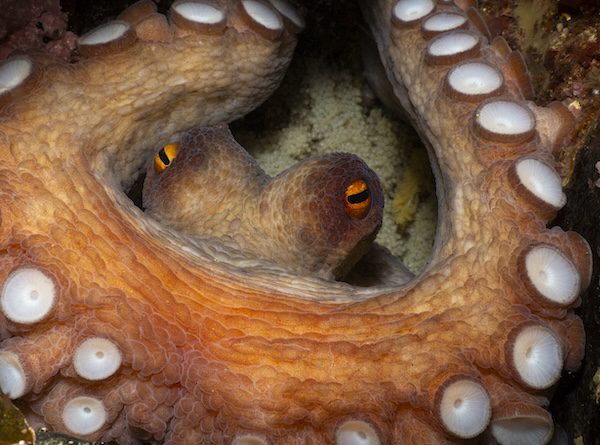
Category Winner: “2025 was undoubtedly the Year of the Octopus. Being such an imposing creature underwater, these intelligent and charismatic animals had brought delight not just to me but many fellow UK divers. Throughout 2025 I’ve been treated to an array of natural behaviour, ranging from hunting pray to mating, but in this case I wanted to capture a females final act of selflessness, as after she lays her eggs she diligently guards, cleans and wafts oxygen rich water over them to keep them healthy,” described Ingram. “During this time which can last for several months, she doesn’t leave their side not even to feed herself, and once the eggs hatch she will sadly die. In this bitter sweet and quite poignant time I spent with her, I wanted to try and capture the narrative of her final few weeks by shooting her face on, and encircling her offspring in the background.”
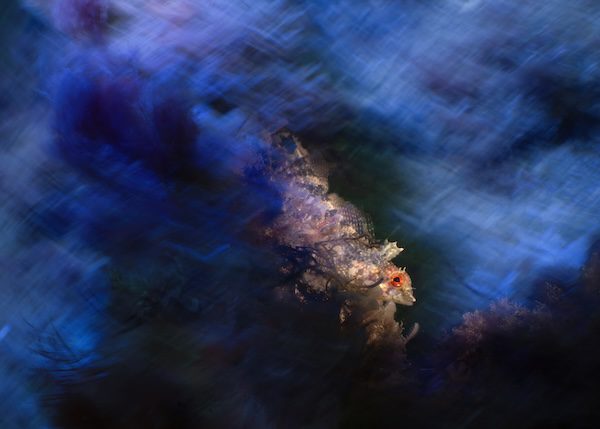
Runner-Up: “Blackfaced blennies are flirty little things at certain times of the year, the females are also very camouflaged against their weedy backgrounds. On this dive under Swanage pier there were pairs everywhere doing their little dances, posing, and flitting about,” Sandra Stalker said.
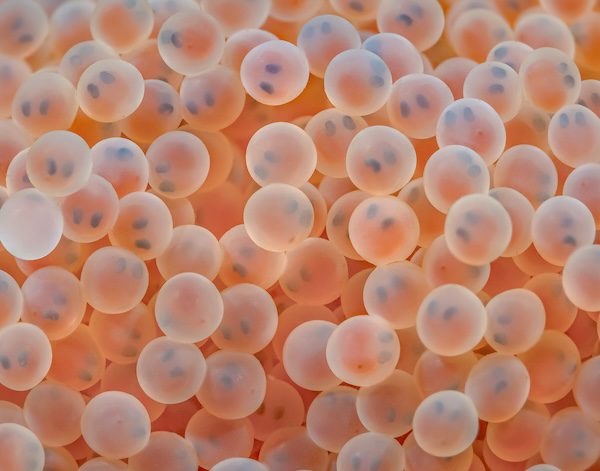
Third Place Winner: Dan Bolt said, “I had to be careful, while getting this shot, not to disturb the attendant adult scorpionfish who was protecting their newly laid eggs. I wanted to capture the tiny, still-forming eyes within each little round embryo, while at the same time having enough depth of field to show just how densely packed they were in the nest.”
British Waters Living Together
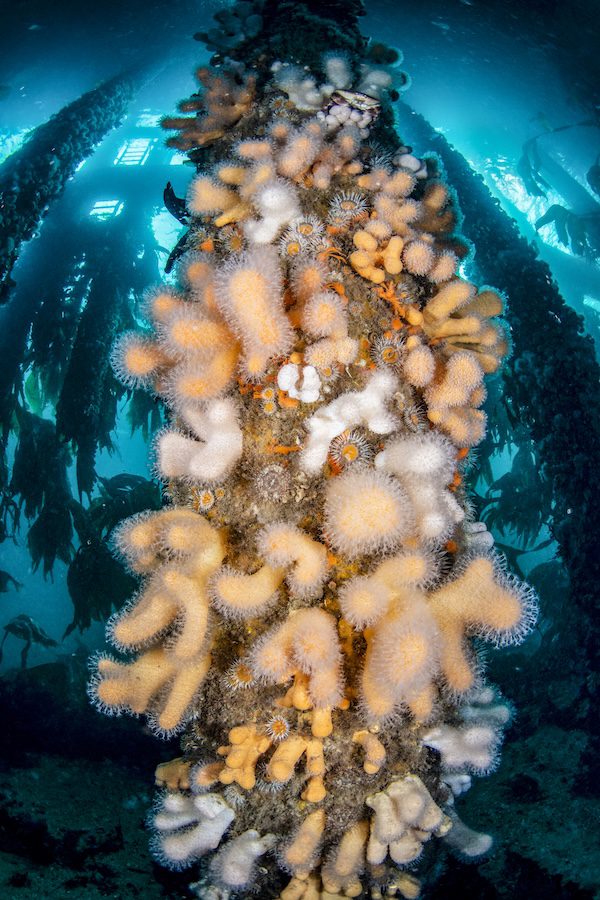
Category Winner: “Last summer, I was fortunate to dive in my native west coast of Scotland after many years, and this pier dive was a particular highlight,” Valerie Reid wrote. “The man-made steel piles provide a great substrate for marine life to grow and flourish. I managed find a pile where the dead man’s fingers soft coral had its polyps out.”
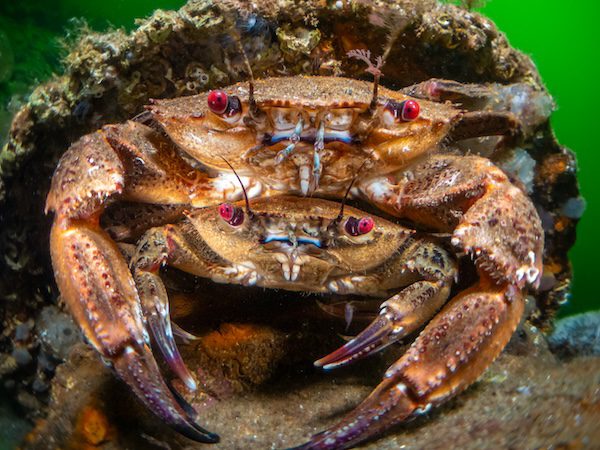
Runner-Up: “Last year I purchased several vintage, or no longer in production, wet-lenses and had a lot of fun experimenting. This shot was taken with the tiny Inon bugeye lens which gives an extreme distortion at a tiny working distance,” wrote Dan Bolt. “[T]hese two velvet swimming crabs weren’t too bothered by my intrusion.”
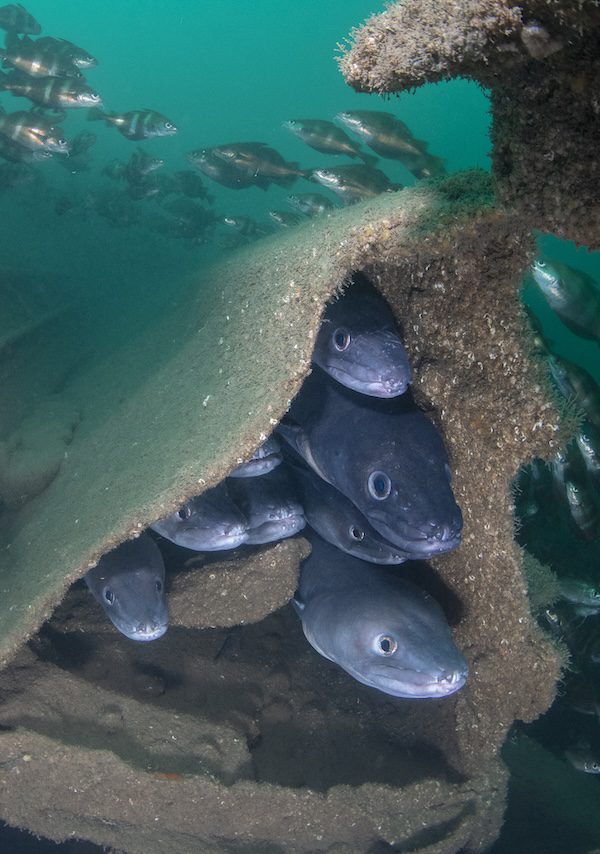
Third Place Winner: “The St Dunstan wreck in Dorset is well worth a visit, full of life as well as interesting structures, being a bucket dredger originally, which was commandeered as a minesweeper in the first World War and then itself sunk by a U-Boat mine in 1917,” Kirsty Andrews said. “On this dive I was immediately surprised by free-swimming congers roaming through the tumble of old dredging machinery, and then surprised even more by this tightly-packed group. It was actually quite difficult to shoot as the congers had made their home in a small crack in the hull, which is not obvious from this angle.”
Underwater Photographer of the Year is an annual competition that celebrates photography beneath the surface of the ocean, lakes, rivers and even swimming pools, and attracts entries from all around the world. To explore the full gallery of this year’s extraordinary underwater images, visit underwaterphotographeroftheyear.com/
Disclosure: This post may include affiliate links.